|
Electricity generation
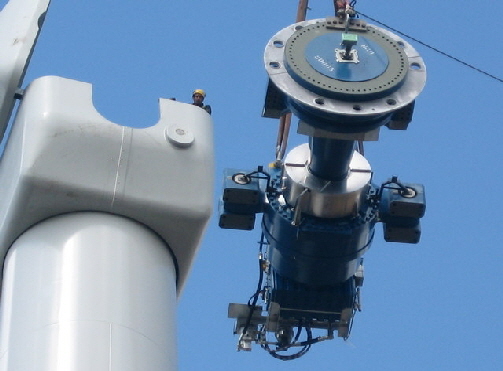
Typical components of a wind turbine (gearbox, rotor shaft and brake assembly) being lifted into position
 In a wind farm, individual turbines are interconnected with a medium voltage (usually 34.5 kV) power collection system and communications network. At a substation, this medium-voltage electrical current is increased in voltage with a transformer for connection to the high voltage electric power transmission system. In a wind farm, individual turbines are interconnected with a medium voltage (usually 34.5 kV) power collection system and communications network. At a substation, this medium-voltage electrical current is increased in voltage with a transformer for connection to the high voltage electric power transmission system.
The surplus power produced by domestic microgenerators can, in some jurisdictions, be fed back into the network and sold back to the utility company, producing a retail credit for the consumer to offset their energy costs.
Grid management
Induction generators, often used for wind power projects, require reactive power for excitation so substations used in wind-power collection systems include substantial capacitor banks for power factor correction. Different types of wind turbine generators behave differently during transmission grid disturbances, so extensive modelling of the dynamic electromechanical characteristics of a new wind farm is required by transmission system operators to ensure predictable stable behaviour during system faults (see: Low voltage ride through). In particular, induction generators cannot support the system voltage during faults, unlike steam or hydro turbine-driven synchronous generators. Doubly-fed machines—wind turbines with solid-state converters between the turbine generator and the collector system—generally have more desirable properties for grid interconnection. Transmission systems operators will supply a wind farm developer with a grid code to specify the requirements for interconnection to the transmission grid. This will include power factor, constancy of frequency and dynamic behaviour of the wind farm turbines during a system fault.
(From Wikipedia, the free encyclopedia)
|




